
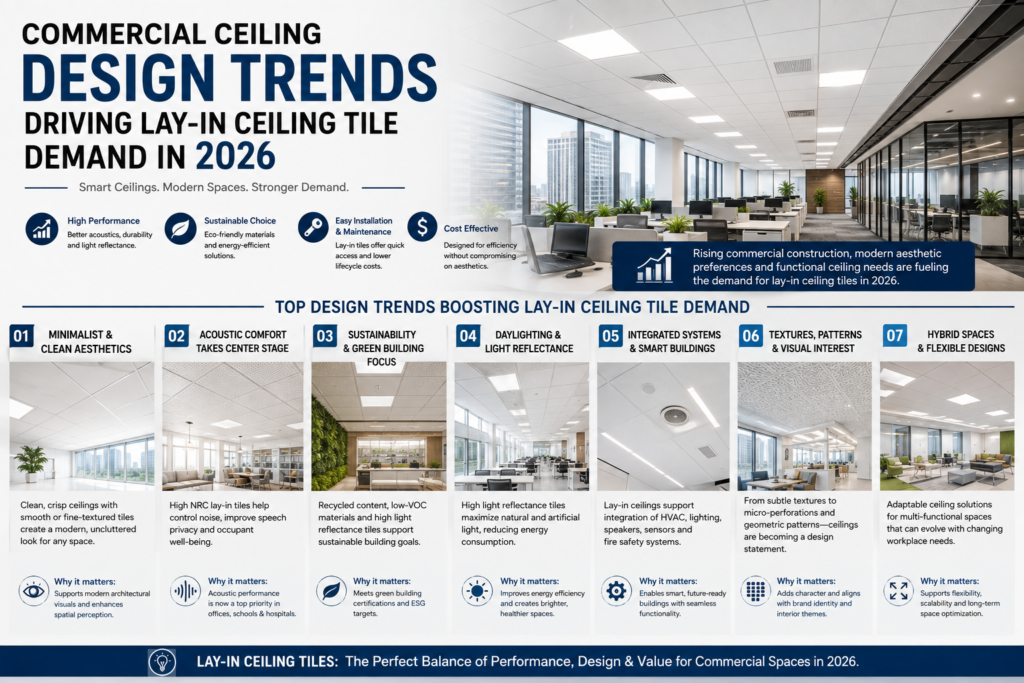
The commercial interior landscape in 2026 is in constant flux, with companies looking to make a positive impact on aesthetics, sustainability, employee health and wellbeing, and operational efficiency.
Today, ceilings are designed and integrated into spaces, not just added as an accessory, and are used in various modern settings, such as offices and hospitals, as well as schools and shops. Lay in ceiling tiles are still the preferred choice in commercial construction for their versatility, ease of installation, and cost-effectiveness among the many choices available.
The ability to easily access HVAC, electrical wiring, and maintenance while maintaining a clean aesthetic is a growing trend in the field of architects and interior designers, and modular ceiling systems are quickly becoming the preferred option. Let’s take a look at the key trends in the commercial ceiling market that are fueling the need for lay-in ceiling tiles in 2026.
1. Sustainable Building Materials Take Center Stage
Green construction is no longer a choice but a must. There has been a shift to greener materials that can help meet the requirements of sustainable building rating systems for commercial projects.
The use of recyclable raw materials and low VOC emissions in the production of modern lay-in ceiling tiles contributes to the improvement of the indoor environmental quality. They also have a long life span, which further minimizes replacement expenses and construction waste. Sustainable ceiling systems are becoming popular in businesses looking for an eco-friendly interior without sacrificing style.
2. Acoustic Comfort is Becoming Essential
Open office spaces have made collaboration more effective but have also posed noise issues. Now acoustic ceiling solutions are a must-have for:
- Corporate offices
- Schools
- Hospitals
- Conference rooms
- Libraries
- Co-working spaces
Good-quality lay-in ceiling tiles absorb unwanted noise, reduce echo, and enhance speech intelligibility. Improved sound quality increases worker productivity, employee focus, and customer satisfaction.
3. Minimalist Commercial Interiors
Clean lines and uncluttered spaces characterize modern commercial space. Simple geometric patterns, neutral colors, and uniform ceiling grids are ideal for contemporary interior themes. Lay-in Ceiling Tiles: Provides sleek ceiling finishes without revealing mechanical systems above the ceiling.
This simple look is great for:
- IT offices
- Financial institutions
- Government buildings
- Educational campuses
- Healthcare facilities
4. Easy Maintenance and Accessibility
Lighting fixtures, HVAC systems, fire sprinklers, and electrical wiring are all areas a commercial building needs to be frequently maintained.
Lay-in ceiling tiles allow easy access to concealed infrastructure in contrast to traditional ceilings. The maintenance of the ceiling can be done in a more cost-effective manner without breaking the ceiling, creating less downtime and maintenance costs.
As facilities evolve and grow, modular ceiling systems become ever more the choice of the facility manager, as they are easier to repair and upgrade.
5. Better Indoor Air Quality
Wellness in the workplace is a primary concern in the design of a workplace. Top-quality lay-in ceiling tiles are developed, making use of reduced-emission materials, which help ensure healthier interior environments. Together with an efficient ventilation system, these ceiling solutions will enhance air circulation and lower the amount of volatiles in the air.
Good working environments lead to improved employee satisfaction and reduced absenteeism.
6. Smart Lighting Integration
Commercial interior lighting is an important factor in interior commercial design. Modern ceiling systems easily accommodate the following:
- LED panel lights
- Smart lighting controls
- Motion sensors
- Emergency lighting
- Integrated HVAC diffusers
Lay-in ceiling tiles’ modular design enables businesses to upgrade the light fixtures when they need to, without big renovation projects.
8. The rise in flexible office spaces
Hybrid working is still redefining the commercial office design. Interiors that can be reconfigured are a growing demand in the world of organizations. Modular ceiling systems allow space to be modified with ease for lighting, partitions, and air-conditioning changes as workspace needs change. This versatility can make lay-in ceiling tiles an ideal choice for contemporary offices.
8. Fire Safety Compliance
There are strict fire safety codes that commercial buildings have to follow. A number of lay-in ceiling tiles are made by fire-resistant materials, which enhance the safety of buildings as per the industry standards.
Architects are increasingly specifying certified ceiling systems that are aesthetically pleasing and additionally provide improved fire performance.
9. Custom Design Options
White ceilings alone do not cut it for commercial interior design these days. There are now a number of different varieties of lay-in ceiling tiles available from manufacturers:
- Textures
- Surface finishes
- Patterns
- Colors
- Edge profiles
These customization options enable designers to design beautiful interiors while ensuring that they remain functional.
10. Cost-Effective Long-Term Investment
The total cost of the system over time is considered and planned; the installation cost is not the only factor. Lay-in ceiling tiles provide value over time in several ways:
- Lower maintenance costs
- Easy replacement
- Improved energy efficiency
- Durable construction
Avoid hiring people to repair the vehicle. Avoid employing workers for repair work.
Conclusion
The key areas of the commercial ceiling design in 2026 are functionality, sustainability, acoustics, and modernity. With the growing trend of investing in healthier and smarter workplaces, lay-in ceiling tiles are becoming the go-to ceiling choice for architects, builders, and facility managers.
They are a future-ready option for commercial interiors due to many of their features, including modularity, amazing acoustical properties, easy maintenance, fire protection, and building system compatibility. Gypsonite provides innovative ceiling solutions, customized to satisfy the ever-changing needs of contemporary business spaces. Elevate the next project with ceiling systems that promise superior aesthetics, ease of installation, and value.
FAQs
1. Why are lay-in ceiling tiles becoming more popular in commercial buildings?
Lay-in ceiling tiles are very flexible, easy to maintain, have excellent acoustics, and can be installed quickly. They also allow convenient access to electrical and HVAC systems, making them a practical, cost-effective, and aesthetically pleasing solution for modern commercial spaces across various industries.
2. Are lay-in ceiling tiles suitable for offices and healthcare facilities?
Yes. They absorb sound, which makes them quieter; they are easy to keep clean and sanitary; and they are suitable for use in high-traffic offices, hospitals, clinics, schools, and other areas that need comfort and functionality.
3. Do Lay In Ceiling Tiles improve energy efficiency?
Yes. A large number of lay-in ceiling tiles improve light reflectance, thus reducing the need for artificial lighting. They also perform well when it comes to HVAC systems, ensuring indoor climate and reducing energy usage in commercial buildings.
4. May the broken Lay In Ceiling Tiles be fitted one by one?
Absolutely. A major benefit of modular ceilings is that each tile can be removed and replaced without disturbing the adjacent ceiling,lay-in ceiling tiles making repairs economical, labor, and operation friendly.
5. What should I consider when selecting lay-in ceiling tiles?
Select tiles with acoustic, fire, moisture, durability, and sustainability requirements; maintenance considerations; and design requirements. When choosing ceiling systems for commercial interiors, it is crucial to opt for high-quality products from reliable manufacturers to guarantee long-lasting functionality, safety, and aesthetics.