
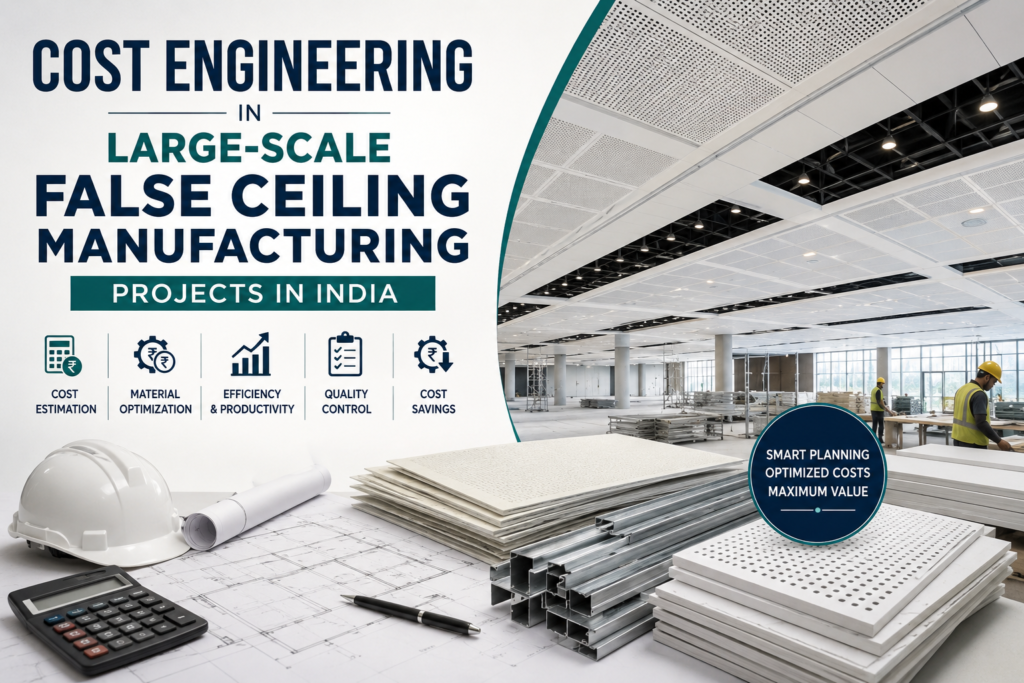
Cost engineering is a pivotal component of successful delivery for large-scale construction projects in the booming Indian construction market. From commercial hubs and airports to high-rise residential complexes, effective cost engineering ensures that projects are financially viable while meeting strict quality, timeline, and performance benchmarks.
As the need for novel space solutions continues to rise, architects and builders are turning to false ceiling manufacturers in India to achieve optimal cost, quality, and deliverability.
Large-scale projects involving multiple cost centers that would require a false ceiling are complex projects. They include raw material sourcing, production, manpower, logistics, installation, quality control, and operational support. All components need to be optimized for minimal waste, no budget overruns, and long-term value—which is where cost engineering fits in.
What Is Cost Engineering and Why Does It Matter?
Cost engineering isn’t only to reduce costs but rather to optimize expenditure for better results without degrading project quality. It includes prediction, planning, cost management, value analysis, risk reduction, and post-project evaluation. Cost engineering applies smart decision-making throughout the production process of the false ceiling, from principle design to execution.
For builders, it is a competitive environment in the Indian market, where they work with various suppliers and manufacturers. In this place, the false ceiling manufacturer in India can make a massive impact on the project cost. Choosing a partner with sophisticated manufacturing skills, solid supply lines, and the scope of cost engineering expertise reduces procurement and execution risks.
Cost Engineering Components in False Ceiling Projects
1. Planning and Design Optimization
The best return on investment from cost engineering is achieved during the planning stage. Designers work with cost engineers to compare various design options for cost and performance.
For instance, differing gypsum board thicknesses, grid systems, and finishes can affect not only material cost but also acoustic performance and durability. In large commercial facilities, with ceiling areas that can span thousands of square meters, strategic design optimization is critical so that the material is not overly specified for no measurable advantage.
2. Accurate Budget Forecasting
Clearly establishing a definite cost estimate early helps when the project is underway to avoid surprises at later stages. Budget forecasting includes material costs (such as gypsum, tiles, metals, and suspension grids), transportation, fabrication tolerances, labor, plant overheads, and risk contingencies. Cost engineers constantly compare these market prices of the top false ceiling manufacturer in India’s suppliers to arrive at realistic market prices.
3. Material Procurement & Supplier Management
The project’s bottom line is significantly affected by procurement decisions. Cost engineers are responsible for supplier competition and negotiation for material quality and competitiveness of costs. Contracting for reliable manufacturers of gypsum board, metal channels, and acoustic tile provides an economy of scale for bulk purchasing of the most important components. Partnering with a reputed false ceiling manufacturer in India ensures assurance of supply, quality certifications, and post-delivery support.
Reducing Waste Through Manufacturing Efficiency
In a big project, the manufacturing’s inefficiencies can make the project extremely expensive. To reduce costs, strategies here include the following:
- Precision Cutting & Optimization Software: Advanced CNC machines and planning software minimize gypsum board scrap, improve yield, and optimize labor flow.
- Lean Manufacturing Principles: Lean practices eliminate unnecessary process steps, improve lead times, and lower inventory costs for manufacturers.
- Quality Assurance at Source—Defect diagnosis in in-line inspection prevents rework in the downstream process, a cost saving when working with large-scale projects.
The choice of the false ceiling manufacturer in India is important because it is the fundamental or basic level of manufacturing efficiency and reliability of deliveries. Project teams can save time and mitigate costs by having a manufacturer with strong cost engineering practices.
Balancing Cost, Quality, and Performance
Controlling and regulating project cost and performance (acoustic insulation, fire safety, moisture resistance, aesthetics, etc.) is one of the most complicated issues faced during false ceiling projects. Cost engineering can help balance these conflicting considerations, as follows:
Value Analysis & Functionality:
Cost engineers use value analysis rather than just choosing the lowest price since they want to consider “cost per function.” For instance, a false ceiling with acoustical properties can be more expensive at first installation but can reduce the number of complaints and retrofit expenses over the life of the building.
Life-Cycle Costing:
Cost engineering not only takes into account the initial expenses but also takes care of the costs associated with use over the product’s life span, such as maintenance, repairs, failure, and replacement. Although an additional initial cost for the higher-quality gypsum board, this can significantly save on expected life costs by decreasing the number of replacements and improving durability.
Optimal Material Mix:
A combination of gypsum panels and mineral fiber or metal tiles may be recommended by the cost engineer to meet certain performance requirements and control costs. While selecting a false ceiling manufacturer in India, it is best to have a partner with a wide variety of product ranges so there is flexibility.
Real-world applications of Indian infrastructure projects.
False ceiling solutions for large-scale projects like corporate headquarters, airports, IT parks, shopping malls, and luxury hotels must also be sophisticated enough and within a strict financial budget. The site here, where cost engineering means making outcomes in tune with architectural vision and budget realities:
- Airport Terminals (LT): Large areas where acoustic performance is required.
- Technology Parks: Modular ceiling to integrate flexible HVAC and lighting.
- Luxury Hotels: Customized gypsum with fines and fire safety!
In all of these cases, cost estimation, measuring suppliers’ performance, and manufacturing optimization were essential. Working with a trusted false ceiling manufacturer in India enabled these projects to stay on schedule, deploy cost-effective materials, and reduce overall financial risk.
Risk Management and Contingencies
For large projects, there are always fluctuations in costs, disruption in supply chains, labor shortages, and/or changes in design. Cost engineers embed contingency plans in budgets and contracts to cushion the blow to schedules and profits. This involves negotiating flexible pricing conditions with a false ceiling manufacturer from India, reserving buffer stocks for essential materials, and having other supplier arrangements in place.
Conclusion
In India, the large-scale manufacturing and installation of false ceilings cannot be carried out without cost engineering. Throughout design optimization, procurement planning, manufacturing effectiveness, risk management, and lifecycle analysis, it guarantees that the project is economical yet meets the performance targets.
By hiring a reliable false ceiling manufacturer in India, you’ll not only streamline your manufacturing and delivery but also stand to benefit financially and functionally with your project.
As a leader of false ceiling manufacturers in India, Gypsonite gives you cost-optimized false ceiling solutions where quality matters. From concept to construction, Gypsonite offers construction, creative design, high quality, and timely delivery solutions with the budget and performance requirements.