
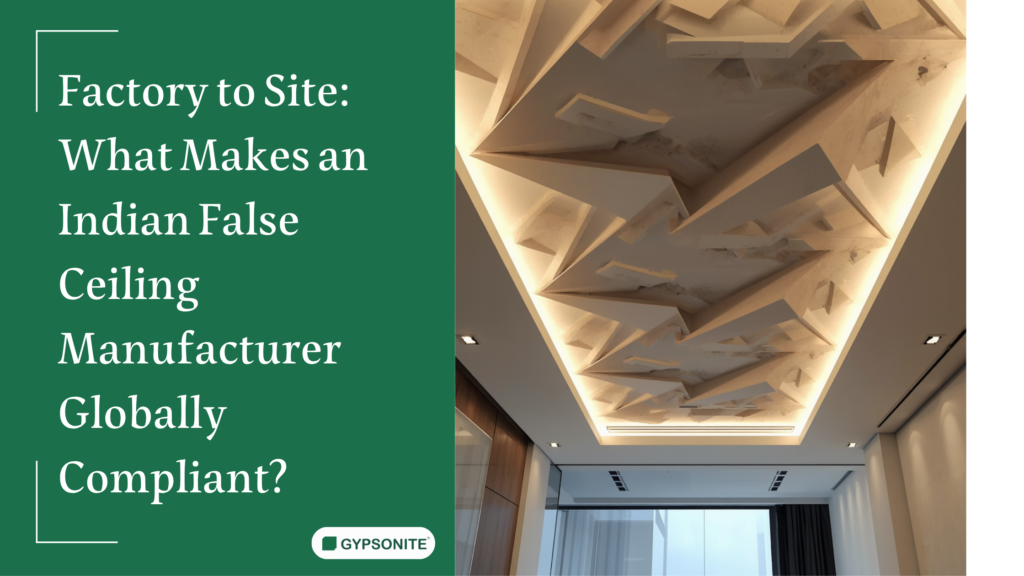
India’s interior infrastructure and construction industry has grown rapidly over the past decade, and false ceiling manufacturing has become a major part of this transformation. From residential apartments and corporate offices to airports, malls, hospitals, and luxury hotels, false ceilings are now essential for both aesthetics and functionality.
But as Indian manufacturers expand globally, one question becomes crucial:
What makes an Indian false ceiling manufacturer globally compliant—from factory production to site installation?
Global compliance is not just about producing a good-looking ceiling. It is about meeting international standards in quality, safety, sustainability, performance, and installation practices. Let’s explore the key factors that define a globally compliant Indian false ceiling manufacturer.
1. Adherence to International Quality Standards
A globally compliant manufacturer must follow strict quality benchmarks such as:
- ISO 9001 (Quality Management Systems)
- ASTM standards (American Society for Testing and Materials)
- EN standards (European Norms for construction materials)
These certifications ensure that false ceiling products meet consistent quality levels in terms of strength, durability, and performance.
Indian manufacturers who export or work on international projects must maintain strict quality checks at every stage—from raw material selection to final product dispatch.
2. High-Quality Raw Material Selection
The foundation of any reliable false ceiling system lies in its raw materials. Globally compliant manufacturers use:
- High-grade gypsum boards
- Mineral fiber panels
- Aluminium and metal ceiling systems
- Fire-rated and moisture-resistant materials
The selection process is critical because different countries have different environmental and safety requirements. For example, humid regions require moisture-resistant ceilings, while commercial buildings often require fire-rated systems.
By sourcing certified raw materials, Indian manufacturers ensure their products perform well across global markets.
3. Advanced Manufacturing Technology
Modern false ceiling production requires precision engineering. Globally competitive Indian manufacturers invest in:
- Automated cutting and shaping machines
- CNC-based panel processing
- Computer-aided design (CAD) systems
- Quality inspection sensors
These technologies reduce human error, improve consistency, and ensure that each ceiling panel meets exact specifications.
Automation also allows manufacturers to scale production for international projects without compromising quality.
4. Fire Safety and Acoustic Compliance
Safety is a non-negotiable factor in global construction standards. False ceiling systems must comply with:
- Fire resistance ratings (Class A, B, or C depending on region)
- Smoke development limits
- Acoustic performance standards (sound absorption coefficients)
For example, acoustic cloud ceilings used in offices or auditoriums must reduce echo and improve speech clarity. Similarly, hospital ceilings must be both fire-safe and hygienic.
Indian manufacturers that test their products in certified labs gain strong acceptance in international markets.
5. Sustainability and Eco-Friendly Manufacturing
Global construction trends are shifting toward sustainability. A compliant manufacturer must focus on:
- Low VOC (Volatile Organic Compounds) emissions
- Recyclable materials
- Energy-efficient production processes
- Waste reduction systems in factories
Many international projects now require LEED certification or green building compliance. Indian manufacturers who adopt eco-friendly practices gain a competitive advantage globally.
Sustainable false ceilings are not just better for the environment—they also improve indoor air quality and occupant comfort.
6. Customization for Global Architectural Needs
Different countries and projects require different design approaches. A globally compliant manufacturer must offer:
- Modular ceiling systems
- Custom acoustic cloud designs
- Decorative and luxury ceiling options
- Flexible sizing and installation systems
Architects and interior designers often demand unique solutions for branding, aesthetics, and functionality. Indian manufacturers that provide customization capabilities are more likely to succeed internationally.
7. Strong Quality Control (QC) and Testing Systems
Quality control is one of the most important aspects of global compliance. Leading manufacturers implement:
- Multi-stage inspection processes
- Batch testing for strength and durability
- Fire and moisture resistance testing
- Acoustic performance validation
Every batch of false ceiling panels must pass strict QC checks before shipment. This ensures that the final product performs consistently across different climates and project conditions.
8. Packaging and Global Logistics Standards
Even the best product can fail if it is damaged during transit. Globally compliant manufacturers invest in:
- Moisture-proof packaging
- Shock-resistant material handling
- Proper labeling and documentation
- Export-grade pallet systems
Efficient logistics ensure that false ceiling materials reach international clients in perfect condition, ready for installation.
9. Skilled Installation and On-Site Support
Factory excellence must match site execution. Many Indian manufacturers now provide:
- Installation training for global contractors
- Technical manuals and CAD drawings
- On-site supervision teams for large projects
- Standardized installation procedures
Proper installation is essential for acoustic performance, durability, and aesthetic alignment. Even high-quality panels can underperform if installed incorrectly.
10. Compliance with Building Codes Across Countries
Different regions have different building regulations. For example:
- Europe emphasizes fire safety and sustainability
- The Middle East focuses on heat resistance and luxury finishes
- North America prioritizes acoustic performance and seismic safety
Globally compliant Indian manufacturers adapt their products to meet these regional building codes, making them suitable for international projects.
11. Innovation and R&D Capability
Innovation is the backbone of global competitiveness. Leading false ceiling manufacturers invest in:
- Research and development of new materials
- Acoustic engineering improvements
- Lightweight yet durable ceiling systems
- Smart ceiling integration with lighting and HVAC systems
Innovative manufacturers are better positioned to meet evolving global demands such as smart buildings and energy-efficient architecture.
12. Certification and Global Partnerships
To build trust in international markets, manufacturers often collaborate with:
- Global construction firms
- Architectural consultancies
- Certification agencies
- Interior design studios
Certifications and partnerships act as proof of reliability and help Indian manufacturers compete with global brands.
Conclusion
A globally compliant Indian false ceiling manufacturer is not defined by production alone—it is defined by end-to-end excellence, from factory to site.
From high-quality raw materials and advanced manufacturing to international certifications, sustainability practices, acoustic performance, and skilled installation support, every step plays a crucial role.
As India continues to expand its presence in the global construction industry, its false ceiling manufacturers are becoming key contributors to modern architecture worldwide. Those who maintain strict global compliance will not only succeed in India but also establish a strong footprint in international markets.